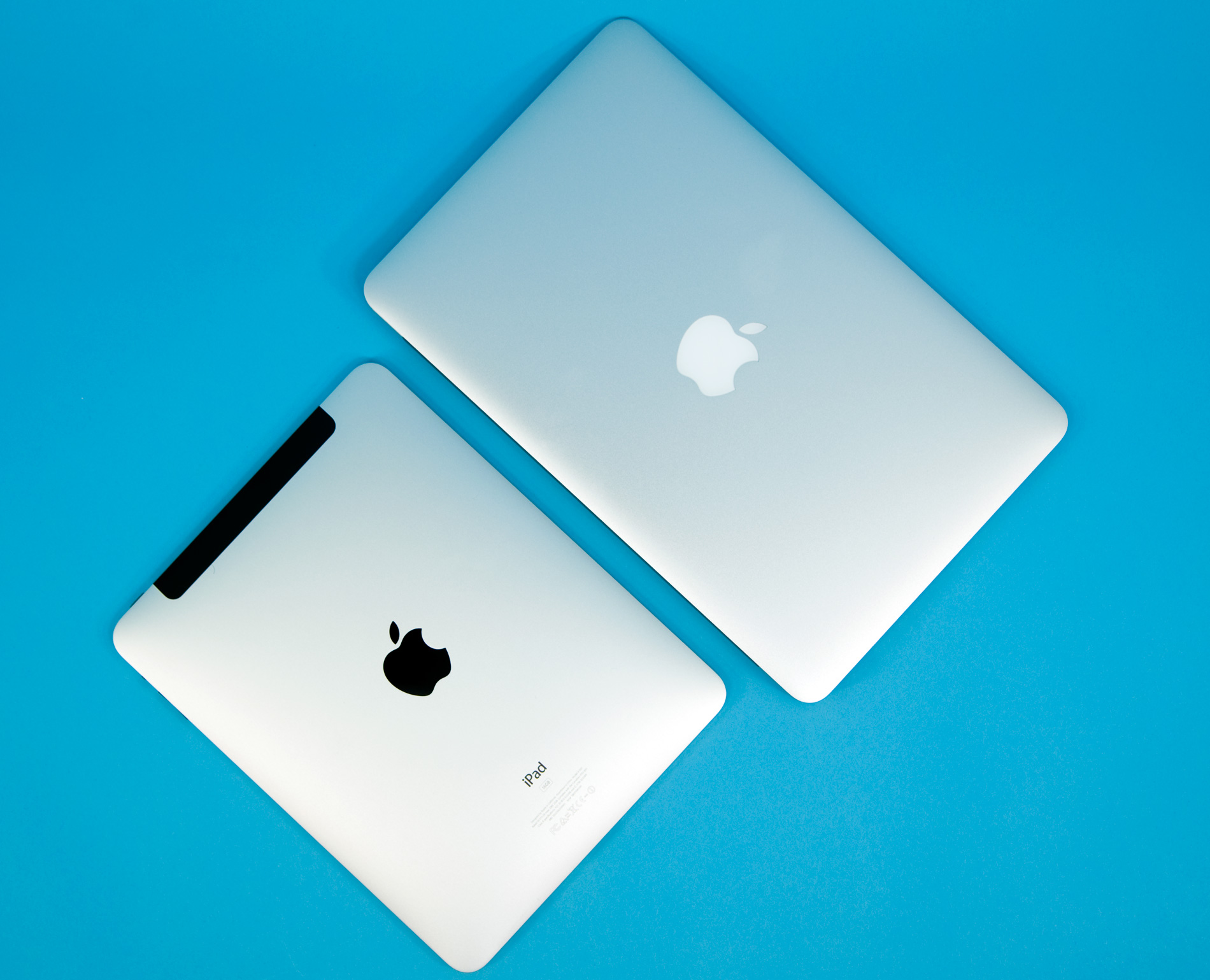
Minimal surface nirvana

Tech Life

Every time Apple introduces a new model of iPad, that old, nasty, stupid, pointless debate rears its ugly head. I’m referring of course to the Can this iPad replace a traditional computer? debate. Also known as Can the iPad become your primary, or even sole computer? Also known as Can the iPad be used for Serious Work?

The constant in this debate is the attitude of the two main user groups involved, as each seems to hold this position: My way is the right way, and you’re a fool for thinking otherwise.

Now, my decades-old habits, my work-related needs, but also my personal preferences put me in the Mac OS / traditional computer group. The way I organise my workspace, the way I multitask, my need for lots of screen real estate, make Mac OS the ideal environment to work in. But I’ve been using iOS and iOS devices for a long time as well. I can appreciate that some people have managed to make them their primary platform and device. I know that Serious Work can be carried out on an iPad. It really, ultimately depends on what you do for a living. 

The point that some iPad die-hard fans seem to miss is that it’s not a matter of people not wanting to adapt to an iOS-based workflow; it’s not a matter of people lacking mental agility to ditch their computers and switch to iPads for work. It’s that their work imposes different solutions, in the form of dedicated software, company-issued computers, multitasking requirements (e.g. ability to monitor more than three applications simultaneously on a bigger screen), etc. 

The point that some traditional computer fans seem to miss is that there are people whose work largely depends on one type of application, and when this type of application is efficiently, effectually ported to iOS and tailored for use on an iPad, a lot of these people will be able and will prefer to work on an iPad, even if some adjustments are required in the process.

But the purpose of this piece isn’t to solve this debate, or to side with either of the parts involved. I just wanted to offer a few observations on this trend towards iPad computing. These past few years I’ve been noticing how a fair amount of tech nerds have made their mission to get rid of desktop or laptop computers and become iPad-only users, and I’ve wondered why. Why are they willing to go back and re-learn to do the same things they used to do on a Mac or PC, on an operating system that is certainly fresher than Mac OS or Windows, but still clearly lacks in versatility (at least in certain areas)?

According to some of them, they prefer iOS on an iPad because it’s “simpler”, and “more fun”. According to others, Mac OS or Windows “never clicked” with them, and iOS has turned out to be a more favourable environment for the way they do things. According to others again, they prefer Multi-touch as input method over mouse or trackpad. There are other reasons, some even more superficial (“I love the design æsthetics of iOS and iOS apps more than the one of Mac/Windows apps”), but let’s stop here for now.

I think there’s another fundamental reason at play, and it’s a stronger driving force than any of the reasons listed above. It has to do with a portability and lightness fever that seems to have affected a lot of people in recent times. 

I don’t know if it all started in 2008 with the first MacBook Air, or slightly earlier with the wave of netbooks, but the obsession with ‘Thin & Light’ has definitely been contagious and has shaped many computing trends of these past ten years or so. The thrill of being able to do most things on a more compact device has been potent; to the point, I think, that which system powers the device is actually a secondary factor. 

Go to any computer store and look at the offerings. The biggest laptop computer size is 15-inch. 17-inch machines are few and they’re all targeted to ‘gamers’ who, in the consumer landscape, appear to be the only category of users putting sheer performance before size or weight. The rest essentially consists of 12/13-inch laptops or even smaller 2‑in‑1 convertible devices.

It seems as if the main goal for the computing environment of the future is that it has to happen on the thinnest, lightest surface possible. The Thin & Light trend is so intoxicating that some people (and I find this hilarious) consider any computer or device weighing more than one kilogram to be heavy. When some learn that I sometimes still do some work on a 17-inch PowerBook G4 — which weighs more than three kilograms — they tell me I’m crazy to carry around that much weight and bulk. 

It doesn’t matter that iOS on an iPad still has its share of shortcomings and convoluted workflows. It’s the thrill of operating a thin slab with just your fingers (and a pencil) what makes the whole experience. It’s the feeling of great convenience. It’s the exhilarating sensation of I can do anything, anywhere, with this paper notebook-sized device.

From a rational standpoint, an iPad may not be the most convenient solution for certain tasks, or even the most practical. But a traditional computer can’t beat that thrill, that feeling of unbearable lightness, when you just grab the iPad from your desktop, put it in your slim messenger bag, and dash out. “I’ll keep checking that thing on the taxi”, “I’ll just shoot her an email while having a cappuccino at the coffee shop near the train station”. Your computing environment on a minimal surface. That is indeed a stronger force than admitting to yourself that certain workflows are still awkward after years of iOS development; that certain gestures are far from well-designed or usability-friendly; that certain features are still hidden behind a curtain of poor discoverability; that a traditional computer still provides a more efficient desktop management and spatial arrangement; that a lightweight, 13-inch laptop with a good keyboard still provides a comparable degree of portability and lightness, with all the advantages of a mature OS.

But the choice that favours the minimal surface with minimal weight is mostly irrational. (And please, don’t read any judgement behind my words. A lot of human choices are based on feelings, not rationality. It’s what makes us unique.) It’s the liberating feeling of striving for a more and more impalpable computing experience. It seems that today what’s more important for both hardware and software is that they ‘get out of the way’. And I can understand this, at least in part. But — and perhaps it’s because I belong to a generation that had time to experience life before the pervasiveness of today’s Internet — I personally still much prefer to perceive computing as a visible, tangible experience; a separate activity, a place I ‘enter’ to work or have fun, but something I can get out of when I need and when I want. 

Because I can’t help thinking that this ‘getting out of the way’ characteristic of the computing experience of the fabled post-PC era doesn’t translate to something that truly gets out of the way, but to something that you bring with you everywhere, because it’s so small, thin, lightweight, and feels so powerful and convenient. You don’t see and hold Alice’s looking glass anymore — you enter it.

iPhone 8 – Scattered notes

Tech Life

1. After an amazing run, it was time to let my iPhone 5 get some deserved rest. About a week ago, I was finally able to purchase a new iPhone. From a general budget standpoint, my two options were a 64 GB iPhone 8 or a 64 GB iPhone XR. From a mere ‘future proofing’ standpoint, the logical choice would have been the XR. Even chromatically the XR looked like the winner, though I would have had a hard time choosing between blue and (PRODUCT)RED.

2. But I chose the iPhone 8. Space grey, 64 GB. Why? The answer is simple: I just like it better. And eight days after my purchase, I can already tell you I love it and I don’t regret choosing it at all.

3. It’s no mystery I dislike the design of the iPhone X line. I dislike the removal of the Home button in the quest to achieve an ‘all screen’ look. I dislike the notch because no matter how hard I try, I can’t unsee it. And I also dislike that these phones keep getting bigger and uncomfortable to hold and operate with one hand.

iPhone XR, iPhone 5/5s/SE, iPhone 8
Left to right — iPhone XR, iPhone 5/5s/SE, iPhone 8. The iPhone XR doesn’t look that much bigger than an iPhone 8, but coming from an iPhone 5’s size, it’s simply too much for me to handle.

4. Ah, but the screen is bigger while Apple has managed to keep the iPhone’s physical size smaller than the iPhone 8 Plus… – I know. But the bezels also work as anchors when you hold the device; they provide a bit of added stability. If there is screen, if there are interface elements to interact with where I usually rest my thumb, then my grip falters, and the device starts slipping away. In the store I managed to drop an iPhone XS Max on the table while trying it out. And I got very close to dropping an iPhone XR too. It’s interesting that it didn’t happen when handling an iPhone 8 Plus.

5. I come from an iPhone 5. Its design and size are simply perfect for my hand and for how I use the phone. In this regard, the iPhone 8 is the minimum size I could get a new, still-supported iPhone. (And yes, I considered the iPhone SE, but I was concerned about the aging internals. Getting a phone with a three-year-old generation SoC didn’t feel wise.)

6. With the hard clear protective case I bought along with it, the iPhone 8 is a bit big for my hand, but it’s still manageable and I can hold it steadily enough while in use.

7. It doesn’t have a notch. It has a Home button. It has Touch ID. Touch ID is fast and accurate. So fast that I still have to remember to avoid pressing the Home button too deliberately or I’ll miss the notifications when I wake the iPhone. The Raise to wake feature is very helpful here.

8. No Animoji. No Memoji. It’s awesome.

9. I did not purchase the iPhone 8 at the local Apple Store, but at a department store with an Apple area inside. It was more advantageous for a series of reasons (I could pay with their affiliate card, the device came with an additional one-year warranty and free insurance against theft, etc.). When I attempted to purchase it the first time, the clerk told me they were out of stock, and to return a few days later. When I did, a second clerk told me: “You’re in luck. We have two units left. The phones arrived two days ago, but these are selling fast.” Hmm. Interesting.

10. I knew this would happen. At the library, a couple of days after my purchase, I wanted to unplug my headphones from the PowerBook and listen to a podcast on the iPhone 8. Whoops, no headphone jack. This still irritates me more than mildly. I went out and bought a Lightning-to‑3.5mm dongle later the same day.

11. Going from an iPhone 5 to an iPhone 8 isn’t so much about mere speed (though that doesn’t hurt, believe me), but smoothness. It’s not the benchmarks per se what astounds me about this new iPhone, but the effortlessness everywhere. Everything feels fluid – I was about to say liquid but I didn’t want to sound like Steve Jobs when he started overusing the term magical. Another element that contributes to this feeling of fluidity is the display itself. It must have a different oleophobic coating because I distinctly feel less friction when moving my fingertips over it.

12. Now that I have a suitable iPhone, I was eager to set up Apple Pay. Of course my bank had to be one of the few left in Spain that don’t support Apple Pay. Of course. Anyway, I’ve finally the opportunity to use Touch ID to authorise a payment when I buy apps on the App Store, and even a few third-party apps (like the one from my mobile operator) have allowed me to use my fingerprint instead of username/password at login. It’s really convenient.

13. The new gestures on the X‑type iPhones are very handy once you get used to them — this is the usual reaction from iPhone X‑type owners, who often also add: I simply can’t go back to having a Home button. Well, while I’ve warmed up to some of them, and while I agree that the app-switching gesture is satisfying (it’s like you’re flipping through a deck of cards), I’m really really glad that on the iPhone 8 I don’t have to invoke Control Centre via that absolutely awkward swipe-down-from-the-top-right-corner gesture. I use Control Centre a lot, and having it come up from the bottom of the display is just perfect.

14. And speaking of Control Centre, it’s great that it can be partially customised. (I know, old news, but bear with me — I’m coming to iOS 12 straight from iOS 10…) What is less great is that it can’t be done… from within Control Centre itself. I just assumed it was possible to long-press or 3D Touch the controls, then the controls would wiggle, and you could rearrange them right on the spot, just like what you do with apps. I had to do a brief Web search to find out that you rearrange the controls via the Settings app, and that you can only rearrange them in limited ways. I’m certainly nitpicking here, but this method just feels so counter-intuitive and so un-Apple.

15. Thankfully, the setup process when going from the iPhone 5 to the new iPhone 8 was rather quick and stress-free, and for a moment I had a glimpse of that It just works I used to love about Apple. I did an encrypted backup of the iPhone 5 via iTunes (wired connection between iPhone and Mac), plugged in the iPhone 8, downloaded a small (and mysterious) software update so that iTunes could talk with the new iPhone, connected the iPhone 8, and restored from that backup. Once the process in iTunes was over, I could see that everything was perfectly cloned on the iPhone 8. Wallpapers, settings, email accounts & passwords, the whole springboard layout. All third-party apps started downloading and installing, and for being more than 100 apps, I was positively surprised by how quickly the iPhone 8 handled everything. Battery-wise, the entire setup cost only two percentage points. Not bad.

16. Some apps were not installed, but I liked that iOS kept them in place, with a little cloud icon next to the app’s name. And I liked that, when tapping on these particular apps, the system gave me a clear explanation as to why (in some cases the reason was that the app is no longer on the App Store, in others the reason was that “This app needs to be updated by the developer to work on this version of iOS”).

17. Okay, I like 3D Touch. And also the haptic feedback. These little nudges you get while interacting with apps make the app feel alive under your fingers. After a week, it hasn’t got old yet.

18. Siri seems more lively and reactive on this iPhone 8. The fundamental issue with Siri hasn’t changed, though. Most of the time it understands my words, just not what I mean.

19. I know, the device is new. But battery life… Battery life is astounding. I’m reaching three days on a single charge.

20. This iPhone will have to last me until Apple manages to deliver a true ‘all screen’ iPhone, without a notch. Yes, I do hate the notch this much.

21. The other day I went back to the store where I purchased the iPhone, and while I was checking whether they had come up with some promotion to sell the previous-generation iPad Pros, I saw three young women trying out the new iPhones. They had an intriguing, somewhat unexpected exchange. It went more or less like this:

– Ah, this is the new one, in colours, the X‑something.

– XR. [She pronounced it ‘eks-ar’, of course. All of them did.]

– The colours are lovely, yeah?

[Pointing at the XS Max and the XR] These are just too damn big.

[Picking up an iPhone 8] I like this one, the eight.

– It’s the same size as your 6S, yeah?

– Yeah, when it’s time I’ll buy this one. I like that it’s smaller and that it has a button.

[Brief laughter]

– No seriously, I like my phone to have a button here, see? Click! I close the app and am back to the start. Just like that.

– I prefer the eight too, you know. At first I got tempted with the 8 Plus, but I returned it after a week. Too big to carry around. And with a case on it? Nah, too much. And for what? Nah, I went back for an eight.

– Yeaah, you’re right… [Fiddles with an iPhone 8] Feels better.

I said this exchange was a bit unexpected because I simply took for granted that they would be more interested in the shinier, newest iPhone models. I’ll admit, part of me was glad that these three regular users were giving some love to the iPhone 8, which has become a bit of a ‘Cinderella iPhone’ in the tech sphere. Their evident distaste for the bigger models was another interesting indicator — not everybody is attracted to ‘the big screens’, Apple. Oh, and in case you want another example of the great divide between tech nerds and regular people, I’ve left the best remark for last: speaking of Face ID as another off-putting detail of the X‑type iPhones, one of the women said: I don’t feel it’s very practical to have to take a selfie every time I want to unlock my phone.

Flickr’s new boss, not the same as the old boss

Tech Life

Flickr’s new management has made a controversial decision for the new year, as you may know by now. As CNET summarises:

SmugMug, trying to strengthen its Flickr site as a community for photo enthusiasts, will limit free members to 1,000 photos and scrap the old policy of a terabyte of storage in an attempt to move toward subscriptions.

The move, accompanied by a 30 percent discount on the $50 annual Flickr pro membership through Nov. 30, is the first big business shift at the photo-sharing site since SmugMug’s acquisition of Flickr from Verizon’s Yahoo earlier this year. And while it’ll mean some members have to decide whether to spend some money or save their photos, it also means Flickr’s interests are directly aligned with those of its members, not those of advertisers, Flickr vice president of product Andrew Stadlen said in a blog post Thursday.

I have been a Flickr member since 2005, and a Pro member since maybe 2006. Historically, this is just one of the many controversial decisions Flickr members had to endure. I don’t remember the various changes Flickr introduced over the years, and making a list of them is not the point of this piece anyway; but I remember that the majority of them were not popular among Flickr’s users. The one I do remember was the site’s major redesign, which I truly disliked at first; it felt sloppy and user-hostile in some areas. It eventually got better. 

But this most recent move? It’s anything but controversial for me. I couldn’t welcome it more.

The bad guy here is not SmugMug, but Flickr’s previous management. Offering 1 terabyte of storage (with ads) to free accounts was a move of Google-like proportions. The problem was that Yahoo was not Google, and this is something more people should have realised at the time, not in retrospect. Do you think that 1 terabyte of storage space is really free? It’s not. Advertising, and your data being passed to advertisers, pays for it. The moment you remove advertising from the equation, giving such enormous storage space to free accounts becomes immediately unsustainable. I am as dense as osmium when it comes to understanding economics, but even I was able to figure this out.

From reading Flickr’s forums, the two primary pain points of this upcoming change are these:

  1. Limiting free members to 1,000 photos means that current free members with more than 1,000 photos in their account will only have access to the 1,000 most recent photos, and all the older ones will be deleted (except those under a Creative Commons licence, if I got this right).
  2. Grandfathered Pro accounts will be automatically charged $49.99 — the same fee as new Pro accounts — instead of $24.95 at renewal time, and there’s no discount or other promotion for them. Some users whose account is bound for renewal shortly are the most annoyed. But I’ve also seen a lot of old-timers like myself complain about this and manifest their intention of not renewing their Pro membership.

Here’s what I think:

  • If you currently have a free account with more than 1,000 photos and you’re uploading materials that you feel have some value for the community, and for the Internet at large (historical photo collections, rare archival images, scanned documents, etc.), then subscribing to a Pro account should be a no-brainer, even at $50/year. If you feel you’re doing important work, and you think it’s unreasonable to pay the service that hosts your materials $4.16 per month, you could always try asking for donations or start a Patreon account.
  • If you — especially after Flickr started offering 1 TB of storage to free accounts — began using the site as your personal photo dumping ground, and don’t want to pay to keep using it that way, consider moving your photos elsewhere, or separating the wheat from the chaff yourself, so that you can showcase your best work, not a whopping 250 bad shots, untitled and untagged, from that cool party you went last week. And hey, if you’re a hardcore cheapskate, you can always open more free accounts and fill them up, 1,000 photos at a time.
  • People hate advertising, but — guess what — they also hate paying to have it removed. There is no free lunch, folks. There’s crappy food and good food, though. If in order to keep a service healthy and sustainable there’s a price to pay, so be it. And I believe $50/year ($4.16/month) is an entirely reasonable price to pay.
  • Storage space has its costs. Don’t start your objections with “But Google Photos offers…” You know how Google makes money, right? You know Google isn’t a charity, right? When most of such costs are paid by advertisers, then you can offer whatever you want to your users ‘for free’. Also, take a look at all the free tiers from companies offering cloud storage services. If they are free tiers which also provide an ad-free experience, usually the amount of storage you’re given is not that huge.
  • Old-time members with grandfathered Pro accounts should be reminded that Flickr started charging $49.99/year for new Pro accounts back in 2015, but kept the price at $24.95/year for all grandfathered Pro accounts with automatic renewal. This grace period, in my opinion, has lasted enough and has been a nice gesture for enough time. I’m sorry, but I just can’t agree with those who say that now Flickr is “charging too much, period.” I may agree in part with those who say that $49.99/year could be too much if there aren’t enough improvements for Pro members in return. But I don’t think the situation is going to stay the same after this significant upcoming change and shift. If it helps eradicate advertising, spam accounts, spam comments, I’m personally glad to start paying $50 a year for a place that’s been an overall stable home and showcase for my humble photos for the past 13 years. (Fun fact: after 13 years I still haven’t managed to upload 1,000 photos…)

In his blog post, Flickr’s VP of product Andrew Stadlen also said:

We want to build features and experiences that delight you, not our advertisers; ensuring that our members are also our customers makes this possible. […] The overwhelming majority of pros have more than 1,000 photos on Flickr, and the vast majority of free members have fewer than 1,000. We believe we’ve landed on a fair and generous place to draw the line.

I agree, especially if you consider that, before offering 1 TB of space to everybody, free accounts were limited to 200 photos. 

To me, it is obvious that these ‘drastic’ measures aren’t being done out of spite or greed. It is also obvious to me that behind this decision from the new management, there’s the intent of revitalising and redefining Flickr’s space and community, which I’ve felt going painfully adrift in recent years. If this change helps Flickr to refocus on being a place where people contribute their best efforts at photography, instead of encouraging users to treat it as just another cloud service to back up gigabytes of their stuff for free, then I believe this change can’t come soon enough.

Faster than its own OS

Tech Life

– Hey, where are you going so fast?
– I don’t know, but I’ll surely get there first.

When talking about the last generations of iPad Pros, something that tech pundits like to point out is their sheer power. Apple excels so much at designing their chips that these iPad Pros are able to outperform most current PCs, even MacBook Pros. In his review, John Gruber brings up the subject almost immediately:

The main appeal of an iPad has always been about the experience of using one. It still is. But put that aside for a moment and consider the new iPad Pro only as a portable computing device. Its performance, both from the CPU and GPU, is simply bananas. It’s nuts. Astounding performance per dollar, astounding performance per watt.

Apple bragged during the iPad Pro introduction that they are faster than 92 percent of notebook PCs sold in the last year. That’s not so funny when you consider that “PCs”, in this formulation, includes MacBooks. iPads were popular and useful when they were much slower than typical notebooks. Now they’re faster than all but the highest-end notebook PCs. They’re just staggeringly impressive, well-balanced computers.

But ever since I started hearing this argument (perhaps since the first generation of iPad Pros), a question that’s been nagging me – a question I still haven’t found a satisfactory answer to – is this: All this staggering performance… to do what, exactly?

I know, you are going to quickly point me in the direction of the example Gruber himself makes in his review – using Adobe Lightroom to edit 50-megapixel RAW images from a high-end digital camera. Good example. I’m sure there are a few others regarding digital artists, drawing and painting with an Apple Pencil, etc.

iPad is more than eight years old at this point. I’d be surprised if it couldn’t do such things. The way I see the iPad today is as if it were a car prototype that keeps getting faster and more efficient at every iteration… and has nowhere to run. Or maybe it does, but it’s a test race track, and it is the only car running on it. To prepare for a competition that never comes. The solitude of the peerless.

iPad is probably the only Apple device with a deep-seated identity crisis. Steve Jobs gave it the right starting point in 2010: a device that could fill the gap between smartphones and laptop computers. Then, over time, that gap has progressively narrowed because smartphones have increased their versatility on one front, and laptops have increased their versatility and portability on the other. What could tablets do at that point? Well, most of them have simply withered away. iPad had the opportunity to redefine its category uniquely and demonstrate that tablets could take advantage of their strengths to become something else, something self-sufficient, capable of redefining personal computing. I like to think that this is what Steve Jobs had in mind, eight years ago.

Some people believe that the iPad has delivered on this in spades, but I’m not one of them. Many power iPad users seem to want this device to become more like a Surface. A 2‑in‑1 device. A shape-shifting tablet that can act like a real laptop when needed. They require a versatility that the iPad, in my opinion, cannot provide yet because it still has an operating system that treats it like a big iPhone, most of the time. iPad is this hybrid entity with the hardware capabilities of a traditional computer, and the mind (software) of a smartphone. That’s one part of the identity crisis. The other part is that iPad still doesn’t know what it wants to be when it grows up. And on the hardware front, it has definitely grown up now.

iOS, in its current form, is still inadequate for the iPad. To truly shine as a tablet, as a portable powerhouse, iPad needs adequate software. It needs apps that really take advantage of all these unparalleled tech specs and hardware capabilities. But it also needs an operating system that’s more thoughtfully tailored to the iPad’s format and user experience. Sure, iOS has become more iPad-friendly with the last two releases, but it just can’t keep up with the hardware. The iPad should have started to have its iOS branch or flavour years ago — I’d say around the time of the third- or fourth-generation iPad at the latest. Just as it makes sense for the AppleTV to have tvOS and for the Watch to have watchOS, it would make even more sense if the iPad had its custom iOS with controls, behaviours, user interface, that treated it like the powerful tablet that it is. 

It’s ridiculous that these new, expensive, iPad Pros, despite having a versatile USB‑C connection, still can’t handle external volumes when plugged in. It’s ridiculous that when you attach a camera or a card reader, the import experience is essentially the same inflexible process as on the first iPad. It’s counterproductive that the operating system still favours first-party applications and not a smoother interoperability among different third-party applications. (Yes, yes, Siri shortcuts… Sorry, not enough.) iPads today are incredible devices with hardware characteristics and specifications that give them unparalleled raw power and flexibility — at least on paper. In practice, hardware is just half of the equation. The importance of software and of an optimised OS mustn’t be overlooked. On Twitter I was making a simple counterexample — that I can still put my first-generation iPad to good use thanks to a good combination of apps, and to a version of iOS (5.1.1) which is so well-tuned to the hardware that makes this iPad more responsive than a third-generation model with four times the RAM, better processor, and iOS 9.3.5.

I think that a good set of apps and a more versatile, more tightly integrated OS with these new iPad Pros should be a given. Instead, we’re still ‘getting there’, while the hardware (design and tech specs) is already beyond there, waiting for the software to catch up. This combination still requires a fair amount of versatility on the user’s part to be effective. This software/hardware gap is especially frustrating when you have iPad Pro configurations that cost more than a traditional, high-end laptop.

Tech’s high speed, and my low tide

Tech Life

This is mostly a rant. Read it as such.

I haven’t written much as of late, creatively or otherwise. Fiction-wise, my works-in-progress proceed at a glacial pace, but at least they proceed. It’s not a creative block, because I know where I want my novel and my stories to go. It’s more like ‘execution fatigue’, if that makes any sense: when stories and plots are complex, there is a lot to check while you actually write. You may have a nice idea to keep the story going, but will the execution of that idea conflict with previous information about a character and/or their arc? Is the new idea so great that it’s worth the additional work of going back and alter previous elements of the narrative so that continuity is maintained? I don’t know if people truly understand the amount of work there can be behind a book. Especially when the author — as is the case with yours truly — has to take care of everything related to the publication of the book.

As for technology, it’s one of those periods when I’m feeling overwhelmed by everything revolving around it. Debates are exhausting. Trying to explain that Facebook and Google are bad for your privacy health is like explaining to smokers and gluttons the long-term respiratory and cardiovascular issues they’ll face due to their habits and addictions. It’s a long, exhausting explanation versus instant gratification and versus the fact that using Google and Facebook services — like smoking a cigarette or eating a chocolate cake — doesn’t seem to be so bad in the here & now. “But it’s so easy, so convenient! Who cares about the implications? I still haven’t seen anything nasty made by Google or Facebook against my privacy…” This is what I get after 15–20 minutes spent carefully and thoughtfully explaining how the adverse effects from trusting these companies with your data may not be immediately noticeable. Or they ask me for solutions. Since I’ve spoiled their fun, now I’m obligated to do their homework for them. “Then how am I supposed to keep in touch with my friends!?” “Then how am I supposed to migrate my email archives and sync my stuff!?” And don’t get me wrong, I often come up with alternatives, but it’s not enough. I try to teach people to fish better, they simply want the better fish served on a plate. When you point out that, at this point, things are leaving the ‘giving advice’ territory and entering into ‘consulting work’ area, which implies a fee, they either get angry or laugh at you.

You know what, then? Keep your Google and your Facebook. Buy their hardware. Let these companies into your own home, give all your data to them. I’ll see you at the next data breach, and it may be a data breach affecting another company you never heard from, but which has your data anyway because they got them from Google or Facebook.

But it’s not just this. It’s not that both regular people and tech nerds can be utterly exhausting to argue with, for different reasons. It’s a general feeling of dissatisfaction and disappointment towards… well maybe more towards the tech world than technology itself. Anyway.

Instant gratification is what seems to be killing perspective, too. If it’s not ‘new’ and ‘now’, it’s not cool. The problem, of course, is that ‘new’ and ‘now’ literally get old soon. The bigger problem is that these two fragile pillars are among the most prominent in the tech world’s foundations today. When talking about my fondness for vintage technology and for putting now-considered-obsolete devices to good use, my interlocutor chuckled and remarked that “nothing lasts forever in tech”. 

Actually I think the tragedy is that today, in tech, nothing lasts enough. This principle leads, for instance, to the discontinuation of perfectly working solutions just because someone says “It’s time to move on” (the headphone jack) and, more broadly, to the let’s fix what is not broken mindset. This principle also creates a general landscape where everything is in a constant beta state. Today, when we encounter something that is under continued development, it’s usually considered a good thing. The flip side, however, is that this something is also never finished; it never really enters a finished state. In most cases, ironically, today ‘finished state’ means when something (software, but also hardware) gets discontinued, abandoned; when its development ceases. 

Finished should mean completed, and I’m already hearing your objection: But Rick, today it’s practically impossible to have a product that is complete and definitive, especially software-wise. And I understand. It’s this obsession with maintaining an unjustified breakneck pace that afflicts everything in tech. I’m not averse to change. I’m averse to this trend that everything has to change as fast as possible because we supposedly need the ‘latest version’ of every damn thing. Progress used to be measured in stages. Today it seems to be measured by speed. If you stop, you die. My present state of mind can only come up with one reaction: fuck this.

We may have different opinions and sensibilities when it comes to enjoying things. As a user of tech products, I feel that lately such products have simply been lasting too little to be actually enjoyed. I’m not talking about manufacturing qualities or the fact that most products aren’t physically ‘built to last’ anymore (though that’s also true). I’m mostly talking about obsolescence and for how long something is considered up-to-date and supported. And I think it’s too short a time, and that it’s also a largely artificially imposed timeframe. Again, the industry has kept accelerating to the point that now the pedal is stuck on the bottom of the car, and I wonder when— no, I wonder if this vicious circle will be broken someday.

To make an example, just imagine if Apple (or any other company with their means, for that matter) stopped introducing new iPhones, a new iOS and a new Mac OS version every year, shifted gears and changed the cycle to just one year and a half. Everyone involved — from Apple designers and engineers, to third-party developers, to end users — would have more time to work on the hardware and software, and to enjoy said hardware and software. More time to hopefully fix bugs that otherwise keep accumulating because by the time you get to look into them, it’s already time to get to work to the next version/iteration of the operating system or application. More time to perform hardware and software quality control. More time to develop for a specific device. And end users would feel they’re really making a good investment by spending more than a thousand dollars or euros in a smartphone.

If this sounds kind of weird to you, you’re probably feeling the pressure of the tech world. But stop and think for a moment. There is no strictly technical reason against slowing down the general pace. The reasons are all commercial. Today, in the tech industry, you’re either the first to release a product, or you release a better product in that particular category. And releasing better products is hard and risky when the shortcut seems to be ‘Get there first, then you can iterate and make it better later’.

Yes, I know, you’re not exactly forced to keep up with technology. It’s not that you have to own the latest and greatest products. But in more than 30 years I’ve never seen such a strong pressure to keep people inside the update loop, so to speak. Update cycles used to be slower: excluding demanding professional needs, you could still use the same computer after 5–6 years without encountering particular issues that pushed you to upgrade. Sure, maybe you ended up expanding the RAM and getting a bigger hard drive or a better graphics card, but you didn’t feel you had wasted thousands of dollars on your Mac or PC after a relatively short while. Fortunately, Apple products have retained a certain degree of longevity, but at the same time they’ve become less internally upgradable and less reliable. The needless complexity of today’s Web technologies doesn’t help, so that a 2012 iPad or a 2013 iPhone, both with dual-core processors and 1 GB of RAM, struggle to load several websites due to the added weight of their cookies and trackers and advertising crap. 

Software quality suffers because of today’s silly race to whatever’s next; as I was saying before, there’s less time to develop and release quality stuff, so you rarely find well-optimised software for the hardware that’s supposed to run it. You often find bloated or badly-optimised software that only the latest hardware can run smoothly. You launch it on your two-year old Mac or four-year old iPad, and you (you regular user) are left thinking that your machine is already inadequate.

The other vicious circle is that, if you want to at least keep up with the latest developments in technology, you have to follow the tech press, and the tech press is another source of the pressure I was talking about. The press gladly feeds on the current breakneck pace of the tech industry. More stuff gets produced, so there’s more to write and talk about. And the press is obsessed with the ‘new’ and the ‘now’. Of course, otherwise there would be nothing to talk about, right? Not that regular people would notice, since it’s basically impossible to reach ‘RSS Feeds Zero’ anyway. And even when there’s actually nothing to talk about, let’s publish some silly comparison, or a poorly-informed but decidedly polarising opinion piece. Let’s talk about how boring that smartphone design is, there’s so little difference with last year’s model, and why don’t companies innovate anymore? Let’s push and push and demand more capable more captivating more inventive and original products than the ones released just six months ago… You take a look at tech channels on YouTube and you soon bang your head on your desk in frustration when you see things like The iPhone 8 in 2018… Still worth it? Spoiler: Yes, yes of course it’s still worth it. It’s still a very capable device, still capable of doing more things than you could possibly throw at it. Yes, the iPhone XS has a better camera, but I see the photos you publish online and you’re going to be fine with the iPhone 8, believe me.

The artificial need for speed, for the new & now, all trickles down to end users. Like pills of tech ecstasy being passed around. So I end up getting emails from friends asking me whether they should buy the new mirrorless full-frame Nikon Z7 camera. I ask what’s their current camera. A Nikon D850 (i.e. last year’s top-of-the-line Nikon DSLR). Why do you want to upgrade, I ask. They write back: Well, it’s a smaller, lighter camera. And it has one megapixel more. And I read that mirrorless cameras are the new direction anyway, so…

What would your response be if you were in my shoes? Mine is as honest as it gets: What can I say? I’ve purchased a second-hand Nikon D200 two years ago (Note: the D200 is a semi-professional DSLR Nikon introduced in 2005) and I still haven’t fully taken advantage of all its features. But if you feel you have outgrown your D850 already [seriously doubting this, even if they were making a living as pro photographers, which they don’t] then sure, go for it.

It has one megapixel more”… Let that sink in for a moment.